


A two-part workshop series exploring how oral assessment can validate student learning, scale beyond the traditional oral exam, and create more meaningful assessment in the age of AI.
Oral exams have gained renewed attention as AI has made polished written work easier to produce. Across this two-part workshop series, educators explored how oral assessment can help reveal student thinking, decision-making, and understanding.
But oral assessment has always faced the same challenge: it works, but it doesn't easily scale.
Kritik brought educators together across two sessions to explore what scalable oral assessment could look like beyond traditional faculty-led exams and AI proctoring. From peer-led verbal defense to new approaches for designing meaningful oral assessment, the series examined how instructors could make student thinking more visible without creating an impossible grading workload.
Session 1: Scaling Oral Assessment Through Peer Learning
September 17 at 2:00 PM EDT
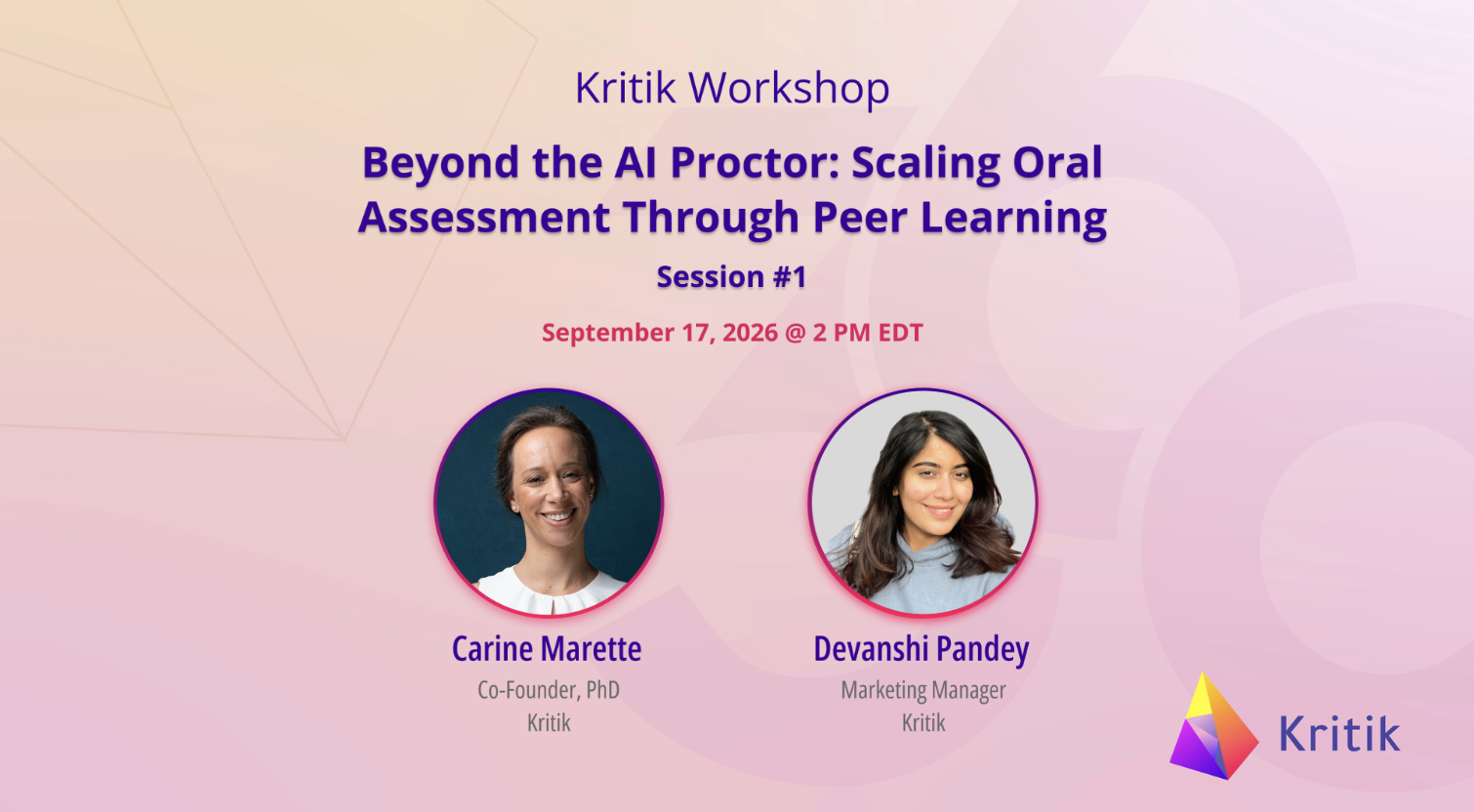
One professor can't sit down with 300 students, which is why institutions have been exploring AI proctors and voice agents to make oral assessment scalable. But does scaling oral assessment have to mean replacing the instructor with AI?
In Session 1, we explored a third path: peer-led verbal defense, where students justify, defend, and critique reasoning with one another. The session examined how peer learning could bring the benefits of oral assessment to larger courses while making the assessment itself part of the learning process.
In this session, we covered:
- Why oral and process-based assessment is gaining attention in the age of AI
- The scalability challenge behind traditional oral exams
- The trade-offs of AI-led and AI-proctored approaches
- How peer-led verbal defense can work within an existing assignment
- A practical approach instructors can apply to their own courses
Session 2: Rethinking Oral Assessment in the Age of AI
September 29 at 1:00 PM EDT
.png)
Making oral assessment scalable was only part of the challenge. How could we make sure it actually revealed what students understood?
In Session 2, we broadened the conversation to explore what meaningful oral assessment could look like as new approaches emerged across higher education. We examined how oral assessment could go beyond verifying whether students knew the right answer and instead ask them to explain, question, defend, evaluate, and reflect on their thinking.
We also explored where peers, instructors, and AI could each play a role, and how oral assessment could become an active learning experience rather than simply another checkpoint.
In this session, we'll cover:
- What makes an oral assessment meaningful and authentic
- How to assess reasoning and judgment, not just recall
- Where AI can support oral assessment and where human interaction matters
- How peer questioning and discussion can deepen learning
- Practical ways to bring meaningful oral assessment into larger courses
Who These Sessions Were For
IThe series was designed for instructors, instructional designers, teaching and learning teams, and academic leaders looking for scalable, meaningful ways to validate student learning in the age of AI.
Together, the two sessions explored the future of oral assessment at scale and practical ways educators can make student thinking more visible.
Register Now!
Download this resource
Please share a few details to get the assets.
Download this resource
Please share a few details to get the assets.